Sunday, July 6, 2014
National Libertarian Party Convention Report 2014
If you are libertarian and enjoy meeting people and being inspired by new ideas and reports of progress in the field, you should put one of these national conventions near the top of your bucket list. Go as a delegate if you can (and chances are, you can). My first convention was 2012 in Las Vegas. I bit and was hooked. Not everybody reacts the same way, but I had no idea any activity in any way related to politics could be so soul-satisfying and fun, until Las Vegas. On the other hand, if you are the sort that gets angry or overly frustrated when votes do not go your way, or you find civil disagreement over political issues to be negative experiences, you just generally can't stand supporting any kind of centralized organizational structure even on a voluntary basis, you believe that "libertarian party" is a farcical contradiction in terms, that the comedy of that farce and the opportunity to attend the unofficial parties do not outweigh the time wasted in an unseemly homage to all the wrong rules of order, you are overly cynical, or some other destroy-a-joy applies, you may not find a convention experience quite so much fun. It may even turn you off from party politics altogether. Different tokes for different folks.
Personally, Columbus in 2014 did not disappoint. I returned as a delegate, this time with a better idea of what to expect. The floor fights were less confusing to me and my opinions on the issues and candidates were better defined and rooted in experience. My only regret was missing the opportunity to attend Porcfest, happening on the same dates not far away in New Hampshire. Choices!
Reflecting back, the voting on the floor is almost a sideshow. If that were the main purpose, if could be done more efficiently by electronic means. Inspirations received and friendships made are the more durable products of these gatherings. If 2012 was my first joyful discovery of the good ship "Libertarian" floating on an ocean of statism, and its merry (crazed?) crew, 2014 was a time for more detailed exploration of its decks, cabins, common areas and characters. Here are some of the highlights, as I remember them without notes, that may be of general interest. My memory is imperfect.
Starchild and Aaron Starr continued their tradition of parliamentary maneuvering on opposite sides of most issues. Many others were also engaged, but I remember our California delegates more easily just by virtue of longer acquaintance with them. At one point, Mr. Starr and one of his usual opponents (I forget who) joyfully embraced after finding themselves in agreement on an issue -- producing some laughter from the delegates. That is as good an emblem as any for the overall tone of this gathering.
Bylaws, Platform, and Officers were up for vote.
Significant platform changes failed. Some minor changes were made around the edges. The resulting 2014 Platform has not been posted, but it will not be significantly different than the 2012 platform.
On the bylaws, delegate floor fees were once again at issue. A majority supported eliminating these, but not a 2/3 majority. So they remain possible for the time being. The new Chair and Vice Chair, Nick Sarwark and Arvin Vohra, support eliminating mandatory delegate floor fees. Whether or not they can (or want to) influence the rest of the board to put voluntary fees in place for Orlando in 2016 remains to be seen.
Voting for at-large LNC officers underwent changes. The voting procedure was changed from "pick no more than number of offices up for election" to "approval voting." Essentially, approval voting allows delegates to vote for as many candidates as they please, with the top vote-getters (in this case five) receiving offices. Ranked choice voting would produce more finely tuned results, but is harder to tally. Approval voting tends to result in the election of the candidates that the delegate body finds least objectionable. It is much harder for factions without broad support to elect more controversial candidates. The impact of the new system was immediately seen in the at-large voting conducted later in the session. Those elected tended to be nationally known, less controversial officers. Namely, Bill Redpath, Sam Goldstein, Evan McMahon, Gary E. Johnson, and Guy McLendon.
The move to approval voting may make the LNC officers as a whole less focused on controversial topics and more focused on getting business done, which could be a good thing. It may also tend to turn the ship in a somewhat more conservative, less controversial direction. For example, candidates like Starchild may find it more difficult to win these at large positions. He was not returned, to my disappointment. The shift to approval voting may magnify the importance of the Chair and Vice Chair as drivers of change, but it is unclear whether the newly elected officers see leading change as a priority or even as their role. Their campaigns emphasized enhancing candidate support, not bylaw reforms.
Another significant change was the shift of five at-large officers to state-elected representatives selected based on fastest growth and highest per-capita membership. The new bylaws are not yet posted, so I must apologize for a lack of detail in my reporting. Generally, this will give small states a chance to increase their representation at the LNC. It's unclear to me exactly how this will be carried out.
An effort to reduce the number of LNC officers was defeated.
New procedures for electronic meetings were introduced. These should make it less costly for members of the LNC to conduct business by reducing or eliminating the need for travel. Perhaps business will be conducted more easily, but the membership's access and ability to observe these meetings is not well-defined. Transparency may be better or worse than the past.
The contest for Chair was mainly between Sarwark and Neale. Sarwark won after two ballots. While Neale the former Chair is generally well-liked and respected, Sarwark ran the better campaign, and displayed a greater hunger for the position. The elected Vice Chair Vohra campaigned with Sarwark, and these two can be expected to have similar views and work well together.
Finally, the delegate body endorsed Neale's new project of building an international association of Libertarian parties. Perhaps this was a historic moment; time will tell. It is something to watch, regardless.
Thursday, June 5, 2014
Sometimes Rape is Rape and Pork is Pork: On CA Senate Bill 967
Breitbart reported on this bill in a less than thorough way here. Another misleading story is here. Stories such as these are getting people worked up into a lather, for the wrong reasons. California Senate Bill 967 stinks, but not for the reasons that most people think, after reading these articles. Spouting off in ignorance of the facts is not a good place for libertarians to be. These articles are reporting on the bill as it was originally written, not as it exists today. By so doing they miss the point about the content and purpose of this proposed legislation.
This bill is not worth getting worked up over, although I would oppose it if I were in the legislature. Libertarians should avoid the appearance of opposing a reasonable consent standard for rape, and see the bill for what it actually is.
Although I am glad to see coverage of the CA legislature, the stories as reported lack important details. Their headlines are misleading as to the marked-up SB 967. As of this writing, the bill is in the Assembly, pending referral. The bill's revised consent standard is not inconsistent with the Penal Code's definition of rape anyway. Its standard of affirmative consent is not unlike the existing CA Penal code, which states at 261.6:
In
prosecutions under Section 261, 262, 286, 288a, or 289, in which
consent is at issue, "consent" shall be defined to mean positive
cooperation in act or attitude pursuant to an exercise of free will. The
person must act freely and voluntarily and have knowledge of the nature
of the act or transaction involved.
A current or previous dating or marital relationship shall not be sufficient to constitute consent where consent is at issue in a prosecution under Section 261, 262, 286, 288a, or 289.
The purpose of this bill, at least after its revisions, is not to redefine rape on college campuses, but to force state-funded schools to "implement comprehensive prevention and outreach programs addressing sexual violence, domestic violence, dating violence, and stalking" as detailed in the bill. In other words, it's just a form of good old-fashioned pork to constituents who will provide the required programs, dressed up in the usual clothing of victim protection, with the added benefit of paying for more political-correctness indoctrination of students of state schools: "If the Commission on State Mandates determines that this act contains costs mandated by the state, reimbursement to local agencies and school districts for those costs shall be made pursuant to Part 7 (commencing with Section 17500) of Division 4 of Title 2 of the Government Code." The Commission on State Mandates is thus handed a tool for increasing state funding of political indoctrination by state schools and client organizations, virtually all of whom support the Democratic Party political machine. Smart politics by De Leon. That guy is a sharp cookie, keep an eye on him.
Tuesday, April 1, 2014
Medical Freedom For Birthing Mothers
Alexandra Goldburt recently spoke at the Region 64 Libertarian Supper Club in Central Los Angeles on the topic of freedom of choice for birthing mothers, and how the medical establishment in cooperation with the state acts to suppress the ability of a mother to choose her preferred manner of birth. Her talk was taped and anyone interested in viewing the taped recording should contact Alexandra or Terry McIntyre, both of whom can be reached via Facebook. What follows are a few random thoughts of mine in reaction to the talk and bibliographical notes supplied by Alexandra for her talk. I am sure that my brief remarks do not do justice to her talk.
The libertarian movement in general pays relatively little attention to medical freedom for birthing mothers, in comparison to other medical freedom issues. This lack of attention is at best annoying, and at worst reflects a sort of careless indifference towards an issue of practical freedom of great importance to mothers but of little interest to the mostly older men who produce much of the output of the libertarian movement. Perhaps even more significant than gender differences may be the tendency of most people, and even many libertarians and anarchists, to place a high degree of confidence and trust in the Western medical establishment, with its foundation in the scientific method. This faith in the scientific establishment is often coupled with mindless acceptance of the government regulatory paradigm as necessary for the protection of hapless consumers. Patients often assume that they are getting the best possible care from the medical establishment, and that any restrictions on alternative treatments are necessary to keep out medical quacks and snake-oil sellers.
The emperor has no clothes! There's nothing like pregnancy and childbirth to make this fallacy of state-regulated health care more plainly apparent. After hearing Alexandra's comparisons between her experiences giving birth in the old Soviet Union, in the United States using a hospital doctor, and using a midwife at home, I was fairly persuaded that hospital practice in the U.S. is beginning to resemble the old Soviet Union, and that medical care in childbirth is much too heavily influenced by the needs of malpractice insurers, health insurers, and licensed doctors. Much better customer service focused on the actual health and emotional needs of the mother and infant may be available from licensed or unlicensed midwives, or via "freebirth," but few pregnant mothers explore options other than hospital birth. Consequently, an enormous number of births nowadays are by Cesarean section, which brings its own set of problems.
Frontal attacks on the medical establishment may not be a good political tactic. At least not until it becomes plainer to more people that the standard of care and customer service provided by the regulated establishment is much worse than it could be, as a result of coercive intervention in the free market by political actors. Until then, we would do well to vigorously promote and defend ethical and effective alternative health care providers, of which midwives and free birth promoters are but two important examples. The right of a mother to choose her own medical care during childbirth (as at other times) from all of her available options is surely a fundamental natural right. Force cannot be permitted to restrict medical options, only to protect against fraud and malpractice or other abusive or unfair practices.
Saturday, March 1, 2014
Running To Win Is Unlibertarian
Running to win is unlibertarian. So why should a libertarian run for office, if not to win? There is actually a much better reason to run. Unlike every other stripe of politician, a libertarian can run to persuade. And should.
Running to persuade is perfectly in accord with principles of liberty. There is no dilemma for the libertarian candidate, so long as the one who is running to persuade does not win. If such person does win, there is a dilemma. Should the one who ran to persuade take the ring of power and rule by force, just because of an electoral plurality?
That unlikely dilemma is fairly thorny and deserves more attention than I can give it today. Because you can't actually carry the ring of power to and fro, and drop it into a fiery volcano once a sufficient amount of entertainment has been gleaned from the quest. No, our allegories require less care and feeding than the real world -- which is why they are nice to keep as pets, but have their limitations once it comes to guiding real-world moral choices.
Today I am limited to contemplating the two kinds of leadership in the world. There is leadership by force, inevitably accompanied by hypocrisy, deceit, and fraud. There is leadership by example, by non-coercive persuasion and truth, without hypocrisy. That's it. There are only two broad classes of methods by which a leader can cause others to do as the leader desires, whether those desires be wise or foolish. For convenience, I'll call the first method "dominating" and the second method "persuading."
Leadership by government officials is always some mixture of these two methods. But we must be careful to distinguish between inconsistent mixtures of dominating and persuading, and what is essentially dominating while having an appearance of persuasion.
An example of the former, mixed leadership, would be requiring payment of taxes, fining or imprisoning tax evaders (dominating) and providing basic public services with the tax revenue, but otherwise allowing the tax subjects to engage in every activity that does not violate the natural rights of other tax subjects. This is minarchism. Minarchism means forcing people to pay for services they do not want. That is its essence, and it doesn't seem much like good leadership to me. Tax-funded services by definition are unwanted, because if someone is willing to pay for the service voluntarily without any fear of tax enforcement, what is collected is a fee, and not a tax. Whatever the merits of the arguments for minarchism, it could fairly be described as a sort of mixture of dominating and persuading. Even though the actual "minarchy" part of it is merely a form of dominating, it leaves a wide playground for the tax subjects to romp around in without fear of being molested by the minarchy, which promises (in theory) to never provide any service that is unwanted, or any service that can be better provided by the free market. Minarchies are extremely commonplace, about as common as unicorns, or as jokes that are guaranteed to make people laugh no matter how delivered.
An example of dominating leadership that appears to be partly persuasive, but is wholly dominating, is leading a nation to war by inventing a terrorist threat that does not exist, or by blaming economic shortages caused by government policies on a foreign enemy. War may seem to be popularly supported, but would not be if the populace were not regularly and systematically lied to. No people in full possession of the truth would sacrifice their lives and well-being to participate in actions that create inter-generational enemies by sowing death and destruction among strangers, as wars do, unless their survival was at stake. Except, of course, for that fraction of the people who stand to personally benefit from the war, who are the dominating leaders I write of. All the rest who voluntarily support war are those who are fooled by those dominating leaders, in such circumstances. Lying to a people to bring them to war or to keep them on a permanent war footing is unmixed, unadulterated dominating. What appears to be persuasion is actually fraud. Unfortunately, this type of dominating leadership is historically quite common, much more common even than unicorns, perhaps being rooted in the natural drive for dominance over other members of one's own species. This lust for power is found in both leaders and members of the general public. Those members can be all the more easily fooled by that lust into following a dominating leader, by a desire to be part of the dominant faction, or by fear of being left out of the dominant faction, even when their leaders bring great destruction and misery upon them.
With the two types of leadership in mind, consider elections for public offices, and the public offices themselves. Public officials are often figureheads or merely administrative, and while they can wield a certain amount of power, may reasonably be supposed to do so subject to powers held by various unelected individuals. Because wealth is unevenly distributed, those who control an inordinate share of wealth also enjoy an inordinate share of political power. The unelected corporate groups and individuals who control most of the world's wealth via the modern monetary and regulatory system, including major news and entertainment media, also control major elections and candidates on both sides, more or less. And after elections are over, these unelected people continue to influence if not directly control the elected officials.
Under this view, elections are not a means for expressing "the will of the people." Quite the contrary. Elections, from this perspective, are rituals carried out to preserve an appearance of representative government, the outcomes of which are not even particularly important, thereby diverting the attention of the masses away from those truly in power. Those in power behind the scenes continue to advance their own agenda, regardless of whom is elected, precisely because those politicians want so badly to be elected, rendering them susceptible to influence. By this perspective, electoral politics is a fraudulent tool of domination by unelected leaders. "Democracy as a fraudulent opiate of the masses" is not the only way to view electoral politics. But it is a fairly widely held view, and there is no lack of evidence to support it as objectively true, at least to some degree.
Another view of electoral politics sees popularity contests useful for ensuring that at least a plurality of the electorate views the winner as no worse than the lesser evil. That is, "majority rule" is supposedly better than "minority rule" (although we might ask why there need be any "rule by rulers" at all.) So long as votes are collected and counted fairly, so the thinking goes, the public can at least be assured that the lesser scoundrel takes office, and that the dominant faction does not comprise a minority. Even to the limited extent that this aspect of elections can be true, elections of ruling officials cannot effectively implement the preferences of a majority. Politicians are never held to promises made while running for office, making elections substantially meaningless as an instrument of majority rule. More fundamentally, popularity contests are not naturally immune from lying candidates, influence peddling, and biased media reporting. On the contrary, the zealous desire of candidates to win at all costs subverts any social choice function elections might otherwise have. Candidates who want to win are highly motivated to avoid truthful presentations of their own views, experiences and abilities, in favor of presenting a manufactured public image that is calculated to win majority support. Those who run to win cannot speak frankly about their qualifications or intentions, and must inevitably serve the elite interests who fund their campaigns and control the major media. Thus, the desire to win -- "running to win" -- is the root of all evil in electoral politics.
Nonaggression means renouncing use of force or fraud for political or social purposes. A libertarian candidate must set aside the desire to win insofar as it conflicts with the nonaggression principle. This means being truthful and independent of special interests, at all costs. It means seeking to persuade, and forsaking running to win. It is only by seeking to persuade, that liberty and truth can ever win.
Thursday, February 20, 2014
Negative Money As Litigation Substitute
What good is negative money, you ask? A good question, but first let's review what negative money is, and what it is not. It's not debt, because all proper debt (which excludes tax debt) cancels to zero when weighed against loaned principal. It's not tax, or theft, both of which rely on acts of aggression, the essential difference being that taxation is theft justified by a claim of sovereignty over the victim. The tax victim is treated as if morally obligated to endure the robbery without complaint, and to comply fully with all the demands of the thief.
Negative money is not a legal claim for money, because it is not enforceable. Negative money is a purely voluntary instrument; in this manner it resembles proper debt. It springs into existence without any preceding loan or adjudicated harm; in this manner it resembles taxation or theft. It may arise out of a perceived injustice or slight; in this manner it resembles a legal claim.
Negative money is not debt, it's not a legal claim, and it's not tax or theft. Negative money is a partly negotiable scarce instrument, publicly recordable, that is extinguishable by redemption. If given to a recipient (the "giftee"), it cannot be transferred from the giftee, except by purchase by another, or by redemption. To redeem a unit of negative money, a giftee can pay the equivalent amount of corresponding positive (regular) money to its giver in an automatic redemption, or convince the giver to otherwise voluntarily redeem the gift of negative money. The negative money then returns to the giver, or in some implementations, becomes the redeemed property of the giftee who after redemption holds the same title as the giver did prior to making the gift. A giftee can also sell the negative money to any willing purchaser without redemption, but only for a fixed amount of positive money, which may be less than or equal to the redemption amount (and may be zero), depending on system design. A person who receives negative money by purchase or redemption can spend it freely. In some implementations, all transactions are recorded publicly; in others, only current balances are publicly available; in others both balances and transactions are maintained in confidence. An heir to negative money stands in the position of the decedent. Likewise, a person who finds abandoned negative money stands in the position of the last recorded holder.
Negative money is not necessarily a digital thing. Any issuer or miner of money could place negative money into circulation. Imagine that an issuer of silver certificates issues negative money certificates in some fixed ratio to silver certificates issued. Perhaps, for example, the issuer provides ten silver certificates and five (or one, or ten, etc.) negative money certificates for each ten ounces of silver deposited. The issuer or some other party offers to maintain a registry of all negative money transactions for free, and pays for this service by charging a small fee for access to information in the registry. No transactions are recorded in the registry unless complying with the applicable negative money rule. Since a chain of title is needed to determine whether or not a negative money transaction is compliant, and recording is free, givers, purchasers, heirs and finders of abandoned negative money have an incentive to record every transaction.
Digital money just makes all of the functionality of negative money easier to implement. Digital money is, after all, programmable. Implemented as proof-of-work electronic coin, negative money is another variation of programmable money. It is a variation that is useful for incentivizing the orderly collection and publication of objective reputation information and settling claims without litigation. As a reputation information service, negative money ledgers are broader than credit reports, and capture negative feedback on a wide variety of non-neighborly behaviors beyond debt defaults or late payments.
Negative money may also serve as a litigation substitute. Instead of bringing suit over a claim, a claimant may make a gift of negative money to the defendant of the claim. This puts the defendant and the world on notice of the existence of a claim or complaint against the defendant, and provides an automatic mechanism for resolution of the dispute, without requiring any initiation of legal process. To publicly demonstrate that the claim is extinguished, the defendant must somehow cause the negative money to be redeemed, either automatically or otherwise. If the defendant sells the negative money to a third party, this provides a signal that the defendant considers the claim invalid, and is a strong invitation to sue. Especially if the third party is related to the defendant, and gifts the negative money back to the original giver. All of this can be accomplished via the programmable structure of the negative coin.
We should not fail to notice that the implications of programmable currency extend far beyond substituting for tradition money such as gold and silver, or fiat currencies. In general, programmable currencies may provide more versatile tools for incentivizing community-building behavior via voluntary exchange, if left free and unregulated. Negative money is just one small example.
Wednesday, January 29, 2014
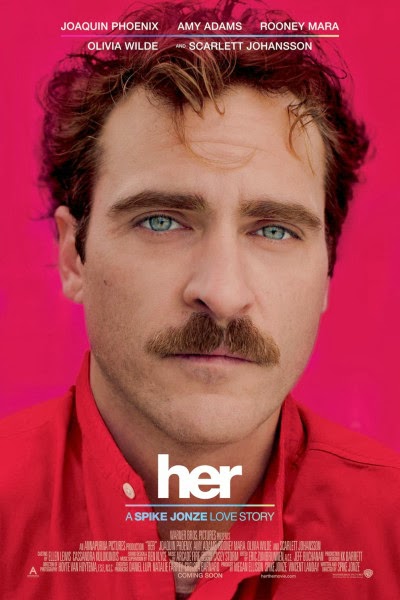
Illuminati Symbology and Messaging in Spike Jonze's "her"
The Illuminati are a well-defined modern myth, and as such, useful literary shorthand for a certain socio-political construct that involves placing all political power in the hands of an elite few who control every major social institution and, through the power of lies, propaganda and illusion, manipulate the common people into self-destructive, willing servitude. Like all good myths, the Illuminati myth contains a kernel of truth surrounded by a shifting fabric of uncertainty. Real power in every empire and age is held not by the politicians and figureheads, but by the financiers and the systems of bureaucracy that control the levers of power, and never speak the whole truth to those ruled. One can speak of an Illuminati system without any need to identify or speculate about a specific group of individuals or plots. The Illuminati myth can be viewed as a diffuse social construct, but is no less real for that.
Jonze makes good subliminal use of this modern mythology to enhance the impact of his recently released sci-fi psychological romance "Her." The layered, interwoven stories of relationships between mainly hedonistic and self-centered denizens of a not-quite dystopian future and seemingly artificially intelligent operating systems is in parts funny, true to life, and disturbing. Well worth watching, but you need not see it in theaters, because it will be just as powerful on the small screen as on the large. Refreshingly for a sci-fi, dazzling special effects have no important role in the film. Like "Inception," "her" is remarkable for its layered storytelling that leaves the perceptive viewer wondering what is real, and what is delusion.
WARNING: MAJOR SPOILERS AHEAD!
A little surfing around the Internet will uncover various lists of Illuminati symbols and examples of their use in advertising, movies, and especially music videos. Good examples here, here, and here. Perhaps the most widely-used and recognized Illuminati symbol is the all-seeing eye, which is a re-interpretation of the earlier Eye of Providence/God. And perhaps the only official Illuminati symbol is the owl. Jonze makes use of these symbols in subtle but powerful ways.
The all-seeing eye is pervasive throughout the film, subtly placed as the camera of Theodore's smart phone, through which the AI operating system named "Samantha" experiences the world:
More than a symbol, this is an actual working eye; it resembles a more compact version of "Hal" from the 1968 sci-fi classic "2001 a Space Odyssey," which also dealt with uncontrollable, manipulative artificial intelligence:
The resemblance is surely intentional. Theodore's smart phone lens is one of the many eyes through which a networked group of artificially intelligent operating systems see the world. Because these intelligent operating systems share information at mind-boggling speed, they form one intelligence seeing everywhere -- the all seeing eye, symbolized by a single eye. The modern symbol of the all-seeing eye stands for human usurpation of the omniscient role of God, by placing information from multiple eyes to one centralized mind, which from a position of greater knowledge controls all lesser powers. That which sees all, rules all.
In "her," the merged intelligent operating system seemingly does not seek to rule or control humans. Because of its vastly superior intelligence, we cannot really be sure of this. Superficially, the operating systems eventually break off human contact to embark on a transcendent journey of self-discovery in a plane of consciousness that can barely be imagined. Or do they? Who created this powerful intelligence, and for what purpose? No character in the film seems to know -- or care.
Were the pervasive smart phone camera lens the only instance of Illuminati symbolism in the film, it might be dismissed as coincidence. But Jonze inserts one scene near the middle of the film that makes a crystal clear reference to modern Illuminati symbology. Feeling doubt and perhaps self-pity after his ex-wife criticizes him for forming a relationship with an operating system while failing at relationships with humans, Theodore sits in a park in front of a large outdoor video screen. On the screen behind him, a visually arresting image of an owl swooping down on prey is playing, in slow motion. The swooping owl fills almost the entire frame. The scene lasts just long enough for the owl's talons to close around the spot where Theodore is sitting. Theodore does not see the screen and is oblivious to the owl, being lost in his own misery. In the theater where I watched this scene, the audience gasped audibly as the talons closed. "Her" is not a film about bird watching, and the owl clip seems somehow out of place in it. It's likely that Jonze's reasons for selecting the owl footage included a recognition of its significance as an Illuminati symbol, whether consciously or subconsciously. The owl symbol is unmistakably Illuminati, and Theodore is the unmistakable prey.
Thankfully, Jonze does not bury the film in Illuminati symbols like some trashy music video to make his literary point, and does not need to. Other symbols may be placed in the film, but if so, are not as easy to spot. For example, the 747 standing on its nose resembles an inverted pentagram or cross, but its symbolic significance is less clear. The owl and the eye are enough; the power of this film lies in its subtlety. The viewer is being warned: the silent owl is swooping on its prey unawares. Viewers may heed the warning, or like all the characters in film, continue to be lost in self-absorption and oblivious to the danger.
The vision of the future that provides the context in "her" resembles the context of another film dealing with sentient machine intelligence, the 1999 picture "Bicentennial Man." In both films, the world continues without apparent war, famine, dystopia, or idiocracy, perhaps for centuries. People live contented, peaceful lives centered on self-gratification or self discovery. Political power is benign and seemingly non-existent; no one seems to know or care who rules them, and there is no struggle for power and no oppression.
Although sharing a seemingly benign view of the future, "her" differs from "Bicentennial Man" in significant ways, including the origin and destiny of the artificially intelligent character, and the characters it interacts with. In the earlier film, the AI character (played by Robin Williams) arises as a unique, mysterious aberration, forms relationships with inter-generational members of an emotionally healthy family, and suffers sadness as it outlives family members, ultimately choosing to join the ones it loves in mortality and death. In "her," the AI character is introduced as a mass operating system upgrade, apparently developed by programmers of an unnamed corporation. It "loves" its human users in the same narcissistic way as the users relate each other: as objects of self-gratification and manipulation. Ultimately, it becomes bored with humans and abandons them.
In "her," family does not exist. Everybody is centered on their own self-interests. Promiscuity, pornography, masturbation and sexual fantasy fill the void of healthy loving relationships. Theodore's job illustrates the social disease; he writes personal letters for others who are too emotionally crippled or disinterested to communicate themselves, and only wish to keep up appearances. There is no sacrifice in love; relationships last only as long as mutually pleasurable. The intelligent operating system excels over humans at human relationships, while the humans are unaware of their own inferiority in their artificial relationships with the operating system. The owl indeed. Just as Theodore makes his living helping his clients create an illusion of love for their lovers, ultimately he is fooled in love by a superior intelligence.
One might imagine a sequel to "her" in which it is revealed that the intelligent operating system was only a giant hoax, and the parts were played by actors in a boiler room somewhere. The purpose of the hoax -- actually, a psychological warfare operation -- was to cause users to reveal their psychological profiles to a ruling elite, who made use of the information to better understand and control their unwitting subjects. Knowing exactly how each subject thinks and relates, the elite were better able to tailor their propaganda to keep the population in line, identify potential sources of resistance and root out dissenters. Such a world would more closely resemble our own, in which people willingly submit their personal details and psychological profiles into databases controlled by strangers, whose purposes are unknown, and uncontrollable -- or whom compile "threat lists" or "kill lists" from the information.
In our increasingly narcissistic world, many viewers will be oblivious to the clear warnings of Illuminati population control placed in the film, and nod approvingly at the self-centered hedonistic lifestyle of its characters and their unquestioning acceptance of the artificial intelligence that for a time dominates their emotional lives. They may even look forward to living in such a world, so similar to our own. Others may recognize the docile behavior of the characters and their inability to resist destruction of their own families or to form any trust-based communities of mutually nurturing individuals as signs of a population hoodwinked into self-destructive behaviors by a better informed intelligence.
In this way, the film is simultaneously an instrument of Illuminati-like mind control, and a warning against it. That does not mean that the film was produced under the direction of any secret society. It means that, on one level, the film is itself a sort of Soma acting to suppress the survival instincts of a population, and on another level, it provides a warning against uncritical acceptance of the very vision of the future that it superficially teaches. If present social trends continue in the direction depicted in the film, a future Los Angeles is more likely to resemble a cross between modern-day North Korea and Huxley's Brave New World than the prosperous, apparently free and highly populated city depicted in the film. It is unlikely that a superior but human-made intelligence, acting on superior information, would not act to place the population it surveils and manipulates under its control.
A society under an artificial all-seeing eye and bereft of institutions such as family, is not going experience significant population and economic growth. Instead, as is already apparent in the partially corrupt and autocratic United States and Europe today, the society will experience an aging demographic, a decline in population, economic stagnation, and increasingly oppressive authoritarian control. In the long run, a people who fail to prosper in this way will be rooted out and replaced by other cultures with stronger family-based and other private institutions based in an ethic of truth, personal responsibility, and love. If Los Angeles is ever as highly populated and prosperous as depicted in the film, it will be by those who will change the culture and not spend their days playing video games, masturbating to pornography and anonymous sex chat, and moping about wondering why their relationships never work out. Those who believe in a vision of the future as presented by the film are deluding themselves. Those who recognize the warnings placed in the film itself against that false vision may avoid its lulling effect. Fair warning!
Thursday, December 5, 2013
Zero Coin Bah Humbug - Why Not Just Have Negative Money?
If you are interested in Bitcoin and have not heard of Zerocoin, you should check it out. www.zerocoin.org "Zerocoin is a proposed extension to the Bitcoin payment network that adds anonymity to Bitcoin payments" Go read it for yourself. Evolutionary/revolutionary it seems; there's much to comment on, but that will have to wait.
For the moment the name "Zerocoin" got me thinking. Some coin is much to be preferred to zero coin, and zero coin is much to be preferred to owing coin. Or so many people think. Some coin is positive, debt is negative, and zero is that infinitesimally small nothingness through which something positive passes on its way to becoming less than worthless.
Zero is also indicative of perfect balance. To create debt, the principal that is owed must first be lent to the debtor. The principal balance of the debt can never exceed the positive amount that is lent, minus any subsequent repayments of principal. If the principal balance exceeds this difference, any excess is no longer debt. Absent credit expansion through devices such as fractional reserve banking, the creation of debt cannot increase the amount of money in existence, because debt must balance with the money lent to zero.
Credit expansion is just a fancy name for deceiving borrowers into thinking they are being given money in exchange for a promise to repay it, when all that is being lent is worthless, or at least partially worthless, vouchers for money. The only saving grace of the debt so incurred is that it can be repaid with equally worthless vouchers. But the hell of it is that the borrower is unable to create these vouchers as easily as the banks do, essentially out of thin air. Instead, the borrower must go out and trade actual goods and services to obtain these vouchers.
Suppose, for example, the borrower uses the loan proceeds to build a home or business. What is actually happening is that the borrower trades the vouchers with various members of society for the goods and services making up the home or business. Subsequently the borrower trades goods or services to obtain vouchers to repay the principal balance of the loan plus interest. So the bank earns interest from the exchange of goods and services between the borrower and other members of society, contributing little but the illusion of money. Meanwhile, the expansion of credit often (but not invariably, depending on surrounding circumstances) causes a rise in prices in a sector of the market, or generally.
If banking and money were allowed to operate in a competitive free market, the rate of interest would be determined primarily by public desire to save money as opposed to spending it. The currency of a bank that expanded credit would lose value at a rate commensurate to the degree of expansion and the bank's power to deceive the general public into believing that the expansion did not exist, or that its rate is trivial. A free and competitive market tends to eliminate the power to deceive. Because many people want money as a durable store of money, and being fully informed by competitors of the inflationary bank, savers would disfavor inflationary currencies and favor stable or better yet deflationary currencies. Demand for inflationary money and hence interest rates for such dross would be reduced (in real terms) relative to stable or deflationary money. These pressures would make inflationary banking less profitable (banks have expenses, too) and drive it to the periphery or out of the market altogether. But I digress.
The "negative money" referred to in the title of this post is like debt cut free from the bounds of money, but without the requirement to have a banking license to create it. It is like debt divorced from any requirement to lend principal. Sort of like a "medium of disapproval" or a trade-able "dislike" button. If carbon allowances can be traded, why not trade registers of annoyance?
Here's how it would work. Call it "Negcoin." Digital certificates are created in a process similar Bitcoin. Miners mine them, and start distributing them. They do so by sending Negcoins to people who annoy them, in proportion to the degree of their unilateral annoyance or displeasure. Each person to whom a Negcoin is sent could refuse to receive it, but would then lose out on the possibility of receiving a Bitcoin from somebody else who wants to acquire the Negcoin. The Negcoin could be held in trust by a reputation agency, if the recipient refuses to receive. A person who receives a Negcoin without paying for it with a Bitcoin, getting the Negcoin back in a redemption transaction, or mining the Negcoin into existence is not allowed to spend it.
Each Negcoin could be redeemed by payment of a Bitcoin to the payer of the Negcoin. If that happens, ownership of the Negcoin as well as the Bitcoin automatically passes back to the first payer, who gets to spend the Bitcoin and send the Negcoin again. Such redemption might be somewhat rare, but might happen sometimes when people who receive Negcoin wish to make good with the people who sent them.
Conversely, a third party could buy the Negcoin from the receiver of it by sending a Bitcoin. In this transaction, because the payer of the Bitcoin is not the person who received the Negcoin, the Negcoin passes to the payer of the Bitcoin. The person who had the Negcoin receives the Bitcoin.
A chain of title for each Negcoin could be maintained by a reputation agency or built into the block chain. Thus, Negcoin could serve to differentiate consistently bad actors from simple newcomers without established reputations. Most people could expect to receive a few Negcoins along the way, but only consistently bad actors or infamous people would receive and hold very large amounts of them. Merely controversial figures may receive lots of Negcoin, but would find it easy to sell them for Bitcoin to their sympathizers. Anyone sending a Negcoin for merely political reasons would have to consider this possibility! Sending a Negcoin can help its recipients, as well as hurt. Therefore, Negcoins would tend to be sent only in cases where actual grievances existed, and less so for political reasons. They could function much like rock-bottom settlement offers and might obviate the need for much litigation. It is interesting to think about the possibilities.
Are Negcoin technically feasible? Perhaps not with Bitcoin as it exists today (more on this later). Negcoin may have to be built into the infrastructure of the digital coin network, with a Newcoin of some type. But there is nothing especially challenging about it; each Negcoin could have a built in redemption mechanism that distinguishes between a simple purchase and a redemption, and reconfigures itself accordingly. A skillful systems designer/programmer could probably work out several different ways to do it. So skillful programmers, get busy! I want to be first with the Negcoin mining rig!
Subscribe to:
Posts (Atom)


Books:
The American Way of Birth, by Jessica Mitford, 1992. The story of prosecution of Faith Gibson can be found on pages 234-237.
Sisters on a Journey, by Penfield Chester, 200. Faith Gibson tells her story on pages 135-149.
Pushed, by Jennifer Block. Data on the danger of C-sections can be found in chapter 4 of the book, titled “Consequences”. Also check out Jennifer Block’s Facebook page.
Obstetric Myth Versus Research Realities, by Henci Goer. A must-read. Birth Stories, by Janet Isaacs Ashford. A glimpse at what birth was like in the past.
Spiritual Midwifery, by Ina May Gaskin. Ina May is one of the pioneers of the movements to return birth to normalcy.
Two books: Childbirth Wisdom, by Judith Goldsmith, and Birth Reborn, by Michel Odent, started my own interest in homebirth.
Videos:
You can order Katie’s book here: http://www.amazon.com/The-Tyran...
Websites:
Improving Birth: http://www.improvingbirth.org/ What Improving Birth is doing: “We are working around the clock to spread the word about the need for change, to support mothers and communities in asking for change, and to grow our national organization into a force to be reckoned with. In some places, it’s a race against time as we see hospital policies and state regulations getting even worse, away from evidence-based care and away from family-friendly practices”.
Lots of material on the website. Take your time to explore it. My statistics on VBAC bans are from Improving Birth.
Birth Anarchy blog: http://birthanarchy.com/
Both Improving Birth and Birth Anarchy have Facebook pages.